
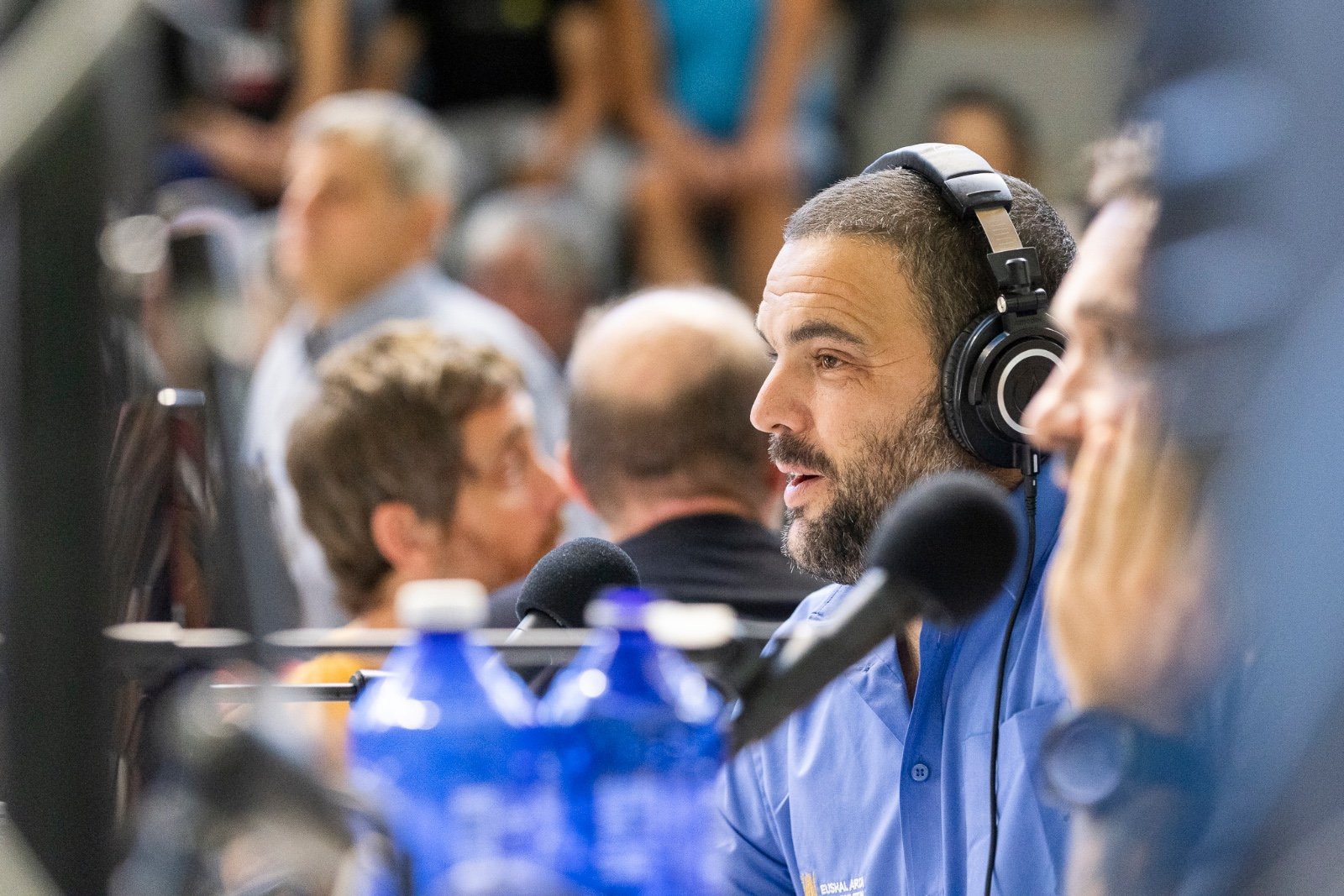
An interview with Joseba Attard, founder and current President of the Basque Shearing Association
Introduce yourself
I am a pot-pourri… a gin & tonic. My name is Joseba, I was born in England, I have a Maltese surname and I identify as Basque. I have lived in Euskal Herria for 20 years. I earn my living shearing sheep and running a hostel together with my wife Joanna, on our farm on the Bizkaian coast (www.olabe.eu)
How did you get involved in shearing?
My dad was a British Wool shearing instructor when we lived in the UK. Occasionally I went with him and helped with woolhandling and wrapping fleeces. It wasn’t until I moved to the Basque Country that I went on my first shearing course in 2013. I now shear regularly with Mikel Etxebarria and Ipar Arrinda and try to help anyone I can through shearing, networking, translating and helping to organise courses and competitions.
What is EAME and how did it come about?
EAME stands for Euskal Ardi Moztaileen Elkartea which translates as the Basque Sheep Shearing Association. In June 2023 at the World Championships in Scotland, I presented a request before the Golden Shears World Council to recognize Euskal Herria as a shearing nation. Over 25% of the countries represented at the World Championships were (and are still) not independent (such as Scotland, Wales, England, Isle of Man, Falkland Islands, Cook Islands, Northern Ireland…) yet they were each able to compete under their flag. The council unanimously agreed that we could take part in international competition. After that meeting and many subsequent meetings with shearers and politicians, we established EAME in May 2024.
Why does EAME exist?
To promote Basque shearing and woolhandling, to defend and support Basque shepherding, to represent the Basque Country internationally and to facilitate shearing, woolhandling and judging training. We are registered as a cultural association. In Basque the word for that is “elkartea”. It means “to unite”. Sadly, there is so much division these days, so it is a difficult task but we try.
What have you achieved so far?
In 2025 we organized our first ever Basque shearing competition that was held in Abadiño (Bizkaia). It was a huge success and served to show people here a glimpse of what competitive shearing is, as well to show the world that we are capable of organizing shearing events that meet international regulations.
We established a shearing circuit in 2025 that would decide who would represent Euskal Herria at the world championships in New Zealand 2026. We fielded a full team including two machine shearers, two wool handlers and two blade shearers. I was the team manager. Out of 27 countries, we finished 15th overall. It was a great achievement. To our knowledge, we are the first sports team to represent all seven provinces of the Basque nation at a World Championships.
Whatsmore, alongside the Falkland Islands, we were accepted onto the Golden Shears World Council, which for us is a huge achievement. It’s like being a member of FIFA for us.
This year in Elizondo, we held our second Basque shearing competition, which was attended and watched by thousands. More and more people are getting involved and we are building a good reputation internationally in the shearing world. People are starting to pay attention.
What support do you have?
EAME is a collective, a movement, a gathering of lots of different people. We are a young association and getting to this stage has involved a lot of sacrifice. Most people have no idea of the amount of work involved, but each milestone we reach encourages us to keep going.
Once we learn to run, we forget what it was like to crawl and walk. You could say that in many aspects, we haven’t learnt to walk yet, but we are standing up on our own two feet. Sometimes we need a helping hand. The French ATM and other Spanish shearers have been a huge support to us. The fact that we can all work together is an example of progress and mutual understanding and respect.
Institutionally and politically, we have tried to involve as many people as we can. It is a political chess game at times, but our doors are open to everyone. We have made mistakes and no doubt we will make more, but our aims are sincere.
On a personal level, I have lost count of how many meetings I have had with politicians, how many kilometers we have driven, road tolls, petrol and flights we have paid for from our own pocket and how many hours away from our work and family we have lost. There is so much work and organizing that goes into making courses, competitions, test matches and trips abroad possible, keeping accounts in order, communication, media and PR. It’s a full-time job.
How is EAME received internationally?
When we go abroad, we tell people that we are Basque. The next question is usually “where is that?”. But when people come here, they realise that we are different. We have our own sheep, unique culture, traditions, history and language. The Maori, Kiwis, Welsh, Irish and Scottish understand this perfectly. The Basque TV channel EiTB made a documentary about our experience in New Zealand called “Moztaileak Munduan” which was well received here.
In the last two years we have represented Euskal Herria numerous times in France, Ireland, New Zealand, Wales and here at our international competition. Next year we have been invited to Scotland, England and back to Wales to shear and to judge.
What has been your experience judging?
I was invited to judge in France in 2024 at various competitions and speed shears. In New Zealand, Neil Fagan asked me to shadow judge alongside himself and Paul Avery. The pressure was on when the likes of Jack Fagan, Rowland Smith and Gavin Mutch can challenge your calls. You have to know the rules inside out and be completely fair and unbiased. I went on to judge at Ohura, Taumaranui, Pahiatua and Apiti, and this year Rhys Jones invited me to judge at Corwen Shears in Wales which was a real honour.
I think every competitive shearer should go on a judging course. It is essential to understand how competitive shearing points are judged, calculated and scored. Earlier this year, we organized a BISCA judging course here we hope to offer more judging courses in the future.
What are EAMEs goals going forward?
EAME is growing which is great. Nurturing that growth is challenging. We need to be a voice that advocates for sheep welfare, shepherding, wool and wool handling, and to inspire young people to consider working in this sector.
The big question surrounding what to do with our wool is ever present. Finding a way to encourage solutions on an industrial level is important. It is a tragedy that such an amazing, natural product is considered a waste product today. We are the only country I know of where farmers have to pay to get rid of their wool. That has to change.
Will we ever see a World Championships in Basque Country?
We get asked this a lot by politicians and international shearers impressed by our shows. We would need at least 4,000 sheep to run such a show and a budget of half a million euros at least. In terms of disciplines like wool-handling, we have a long way to go, but following the successes of our two big shows, there seems to be a desire to keep the ball rolling. Getting shearing registered as a sport in the Basque Country would be a big step forward, but so far our government has been silent in this regard. Perhaps this will change.
Finally, what advice would you give other countries?
There is a lot of potential for countries to showcase their cultures and give their talented shearers the opportunity to shine on the big stages and pitch themselves against the world’s best. You don’t need an association to do that, but it helps. It creates opportunities for developing and progressing. Having someone in your core team that understands, speaks and writes in English well is important too. I asked Jack Fagan why New Zealand shearers are so good. He replied that their courses are close to perfection. The same for Wales. How many times have shearers taken handpieces apart? They are taught this from day one. We have a lot to learn, but they are willing to share their knowledge. If we can humble ourselves a bit, I think that would go a long way.